PWM and MPPT are the two ways a solar charge controller moves power from the panels to the battery. PWM pulls the panel down to battery voltage. MPPT keeps the panel at its most productive voltage and turns the surplus voltage into extra charging current. MPPT harvests more, especially in the cold, and costs more. PWM is enough for a small, simple system.
For a lithium iron phosphate (LiFePO4) system, choose MPPT when the panel voltage is higher than the battery voltage, the array is more than a panel or two, or winters are cold. Below: how each type works, how to size its current and voltage limits, and what to set for LiFePO4.
What a solar charge controller does
A panel is not a battery charger. Its voltage and current swing with light and temperature, and an unregulated panel can push a battery far past its safe charge voltage. The controller sits between the two and:
- Regulates the panel’s output to the voltage and current the battery should receive.
- Stops overcharge by limiting the voltage once the battery is full.
- Disconnects at night, so nothing flows back from the battery into the dark panel.
PWM and MPPT both do all three. They differ in how much of the panel’s power they harvest.
PWM and MPPT in plain words
PWM (pulse-width modulation) acts like a fast switch between panel and battery. While charging, the panel is effectively connected to the battery, so its voltage is pulled down to battery voltage. A panel gives full power only at its own maximum-power voltage, usually well above the battery’s, so part of the potential power is left unused. That is acceptable in a small system whose panel’s nominal voltage matches the battery, such as a 12 V-nominal panel (typically about 18 V at maximum power) on a 12 V battery.
MPPT (maximum power point tracking) continuously finds the voltage at which the panel produces the most power, holds it there, and converts that power down to battery voltage. Power in roughly equals power out, less a few percent of conversion loss, so the extra voltage becomes extra current. Higher-voltage panels, or series strings, can therefore charge a lower-voltage battery.
Example: a 100 W panel with a maximum-power point of 18 V and 5.6 A, held at 13.5 V by PWM, delivers about 5.6 A × 13.5 V = 76 W. MPPT converts the full 100 W down to 13.5 V: about 7.4 A before losses. This idealised case sits near the top of the usual range.
MPPT vs PWM side by side
| Point | PWM | MPPT |
|---|---|---|
| Efficiency in cold weather | Loses most: a cold panel’s voltage sits further above the battery’s | Gains most: the extra voltage becomes charging current |
| Panel voltage flexibility | Must match the battery’s nominal voltage | Higher-voltage panels and series strings, up to the maximum PV input voltage |
| Wiring and cable size | Panel cables carry the full charge current | Series strings carry less current, easing long array runs |
| Cost | Typically lower | Typically higher |
| Best for | Small systems, matched 12 V panels, warm climates | Larger arrays, higher-voltage panels, cold climates, 24 V or 48 V banks |
Commonly cited MPPT gains range from a few percent up to roughly 30% over PWM: largest with cold panels, a higher-voltage array and a partly discharged battery, smallest with hot, matched panels and a nearly full battery. Treat that as a typical range, not a promise.
Sizing the controller’s current rating
The controller’s rated output current must cover the array’s power at the battery’s charge voltage: array watts ÷ charge voltage = amps. Use the charge voltage, not the nominal voltage, and round up to the next available rating.
| Example | Array | Charge voltage | Array W ÷ V | Controller class |
|---|---|---|---|---|
| 12 V camper | 400 W | 14.6 V | 400 ÷ 14.6 ≈ 27.4 A | 30 A class |
| 24 V boat | 800 W | 29.2 V | 800 ÷ 29.2 ≈ 27.4 A | 30 A class |
The same rating handles twice the array power at 24 V, one reason higher system voltages suit larger arrays (see the guide to 12 V, 24 V and 48 V system voltage). Treat the result as a minimum: cold, bright days can bring an array close to its rating, and a partly discharged battery has a lower voltage. For PWM, size against the array’s short-circuit current instead. Keep the charge-current limit within the battery maker’s maximum; the guide to sizing a LiFePO4 battery bank shows how to find it.
Keeping the array voltage inside the limits
Upper limit: cold open-circuit voltage. The open-circuit voltage (Voc) of silicon panels rises by roughly 0.3% per °C below 25 °C (77 °F); the panel datasheet gives the exact coefficient. A series string’s Voc at the coldest expected temperature must stay under the controller’s maximum PV input voltage. The datasheet number is the limit.
Example: two panels of 37.5 V Voc each make 75 V in series. At −10 °C (14 °F) the rise is 35 °C × 0.3% = 10.5%, so about 83 V: fine for a 100 V controller, not for a 75 V one. A third panel would reach about 124 V and rule out a 100 V controller.
The hard limit
Exceeding the maximum PV input voltage can destroy a controller instantly. The worst moment is a clear, cold morning. Leave margin below the datasheet figure, and stay within the maximum PV input current too.
Lower limit: working voltage. The array’s voltage at its maximum-power point must stay well above battery voltage, including on hot days, when it falls by roughly 0.4% per °C; datasheets state a minimum PV voltage. Example: a panel with 31 V at maximum power falls to about 27 V with cells at 60 °C (140 °F). That suits a 12 V battery at 14.6 V, but is too close to 29.2 V on a 24 V bank, where two panels in series are better.
Series adds voltage and parallel adds current, as with battery cells; see the guide to LiFePO4 series and parallel wiring.
Setting a controller up for LiFePO4
- Charge profile. Choose the lithium profile, or enter user-defined voltages matching your battery’s specified charge voltage (many 12 V, 4-cell packs: around 14.2–14.6 V; check the datasheet).
- No lead-acid extras. No lead-acid temperature compensation unless the maker says so, equalisation off, float as the maker specifies.
- Cold cells. Most makers specify no charging below 0 °C (32 °F), and a controller does not know cell temperature: see the guide to LiFePO4 cold-weather charging.
- System voltage. Set 12, 24 or 48 V manually; auto-detection can misread a deeply discharged battery.
When the BMS disconnects
A BMS can open the battery connection at any time: battery full, too cold, over-temperature. Check that the controller’s documentation allows for losing the battery while panels are connected. Connect the battery first and the panels second; disconnect in reverse. A pack that shut down on low voltage may need the maker’s wake-up procedure.
Decision rules and choosing a model
- Choose PWM for a small system with one or two panels whose nominal voltage matches the battery, short cable runs and a mild climate.
- Choose MPPT when the panel voltage is higher than the battery voltage, the array is larger, winters are cold, the bank is 24 V or 48 V, or you may add panels later.
- Either way: current rating at least array watts ÷ charge voltage, lithium profile set, fuse at the battery, cable sized for current and voltage drop. For MPPT, also cold Voc under the maximum PV voltage. A fixed installation deserves a qualified installer.
Bluetooth or app monitoring is a convenience, not a safety feature; if you need it, check that the controller’s documented features include it.
Solar charge controller and power station
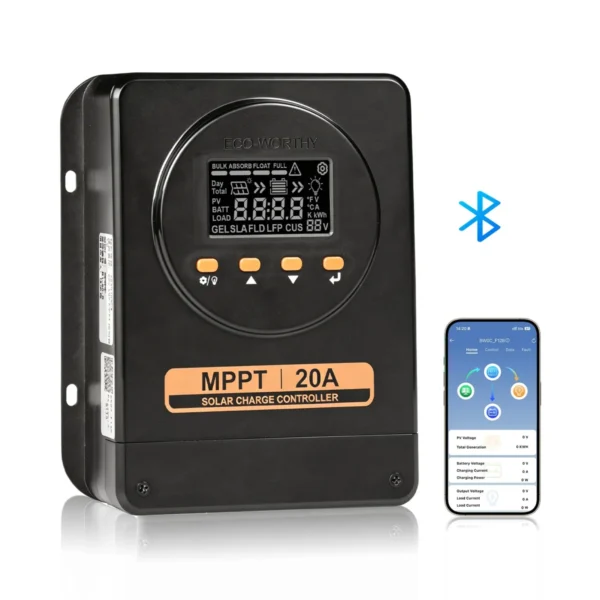
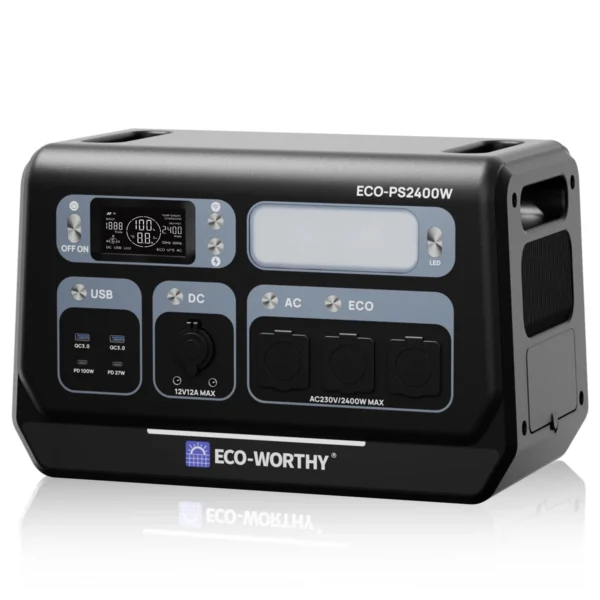
Use the cards to compare, then open each product page and read the documented ratings: controller type, maximum PV input voltage, rated charge current, supported battery types and lithium or user-defined profiles. A power station with a solar input has its own built-in controller, so the same checks apply to its documented PV input limits.
Frequently asked questions
Is MPPT worth it for a 100 W panel?+
Often not by much. For one 12 V-nominal 100 W panel on a 12 V battery in a warm climate, PWM is reasonable, and even a 20% MPPT gain is only about 20 W. MPPT earns its place with a higher-voltage panel, cold weather, or plans to add panels.
Can I connect panels of different wattage?+
With care. In parallel, panels of similar voltage can differ in wattage because their currents add. In series the weakest panel limits the current, and a controller input tracks only one maximum-power point. Build each string from identical panels where you can.
What size controller do I need for 400 W at 12 V?+
400 W ÷ 14.6 V is about 27.4 A, so a 30 A-class controller is the minimum. For MPPT, also check the string’s cold Voc against the maximum PV voltage, and the battery’s maximum charge current. For headroom, take the next size up.
Does MPPT work in cloudy weather?+
Yes, it keeps tracking as the light changes, but it cannot create energy that is not there: under heavy cloud a panel delivers only a fraction of its rating. A higher-voltage array can help it keep charging in dim light.
Can I connect the panel directly to the battery?+
Not to a LiFePO4 battery. A 12 V-nominal panel can reach about 22 V open-circuit, far above a 12 V LiFePO4 charge voltage, and a BMS protects by cutting off, not by regulating. Use a charge controller.
Currents, voltages, temperature coefficients and gains above are arithmetic examples or commonly cited typical ranges, not promises. Ratings on the product pages are supplier-stated and not independently tested by PVShop. Follow your battery and controller manufacturers’ specifications, fuse the battery, and consult a qualified installer for fixed installations.