Description
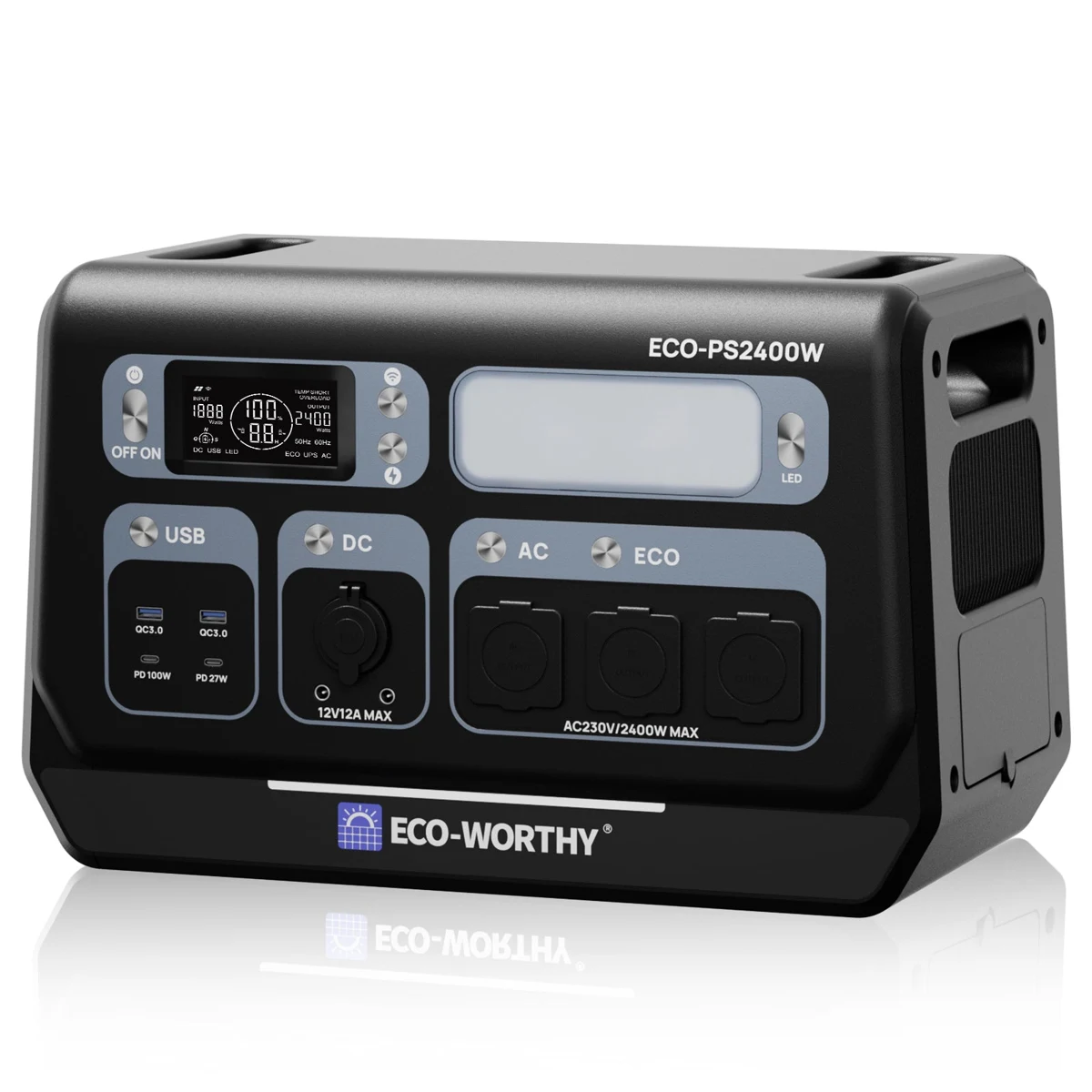
The ECO-WORTHY ECO-PS2400W EU portable power station combines a 2,048Wh LiFePO4 battery with a 2,400W continuous pure-sine-wave inverter and 230V / 50Hz AC outlets. It is an integrated alternative to assembling a separate battery, inverter and charging system, for portable equipment or temporary backup once the connected load is checked. This listing is the EU version, not a US 120V model or a solar-panel bundle.
Ports and outputs
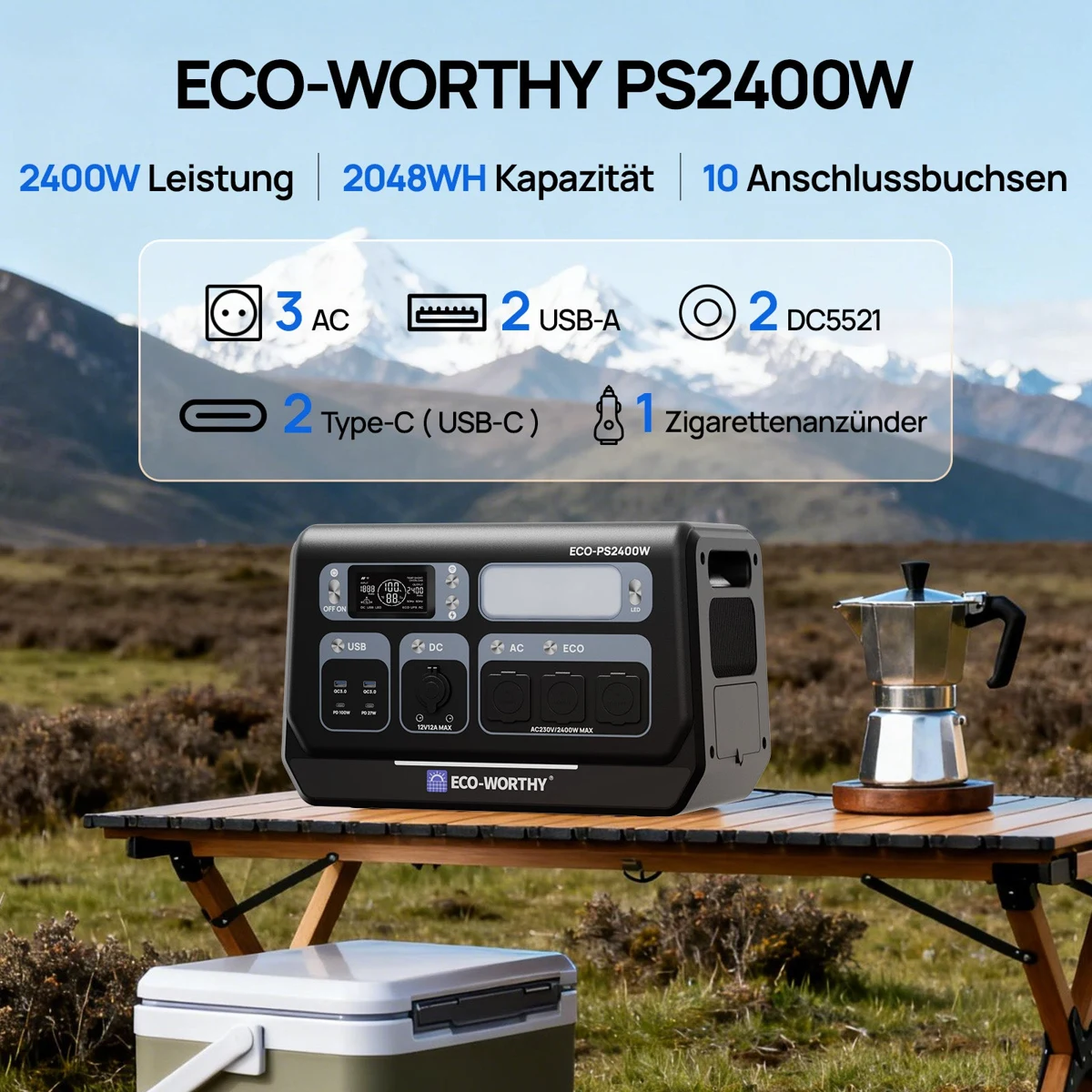
The front panel has 10 outputs in separate USB, DC and AC sections, each with its own on/off button, so up to 10 devices can be connected at the same time. Every port has its own limit and the groups share totals: the three AC outlets share the 2,400W continuous rating (it is not 2,400W per socket), and the 13.8V DC outputs share 12A. The 4,800W peak figure has no documented duration and must not be used as a sustained-load rating. Check each appliance and cable against the limit of the port it uses.
| AC outlets (3) | 230 V / 50 Hz pure sine wave; 2400 W continuous combined; 4800 W peak |
|---|---|
| USB-C PD output 1 | Up to 100 W: 5 V/3 A, 9 V/3 A, 12 V/3 A, 15 V/3 A, 20 V/5 A |
| USB-C PD output 2 | Up to 27 W: 5 V/3 A, 9 V/3 A, 12 V/2.25 A, 15 V/1.8 A, 20 V/1.35 A |
| USB-A Quick Charge 3.0 outputs (2) | Up to 18 W each: 5 V/2.4 A, 9 V/2 A, 12 V/1.5 A |
| 12 V car socket (cigarette lighter) | 13.8 V, up to 12 A |
| DC5521 outputs (2) | 13.8 V, up to 5 A each; 5.5 × 2.1 mm barrel |
| Shared DC limit | 12 A in total for the car socket and both DC5521 outputs |
| Low-battery cut-off | AC outlets switch off at 5% charge; DC and USB outputs at 3% |
Charging inputs and charging times
The AC charging inlet and the DC input for solar and vehicle charging are on the side panel. Pass-through charging is supported, so connected devices keep running while the station recharges.
| AC charging input | 196–264 V AC, up to 1500 W; Q (fast), N (normal, default) and S (silent) modes |
|---|---|
| Solar input (XT60) | 16–100 V DC open-circuit voltage, up to 25 A, up to 1200 W |
| Vehicle charging input (same XT60 input) | 12–32 V DC, up to 320 W |
| AC charging time, manufacturer-stated | Q: about 1.1–1.2 h; N: about 3–3.5 h; S: about 6–7 h |
| Solar charging time, manufacturer-stated | 1 × 200 W panel: about 12–13 h; 2 × 200 W panels: about 6–7 h (full sun) |
| 12 V vehicle charging time, manufacturer-stated | About 19–21 h |
Charging times are manufacturer figures, not PVShop measurements. At the documented 1,500W AC input limit, a full 2,048Wh charge takes at least about 1.4 hours before losses, so treat the Q-mode figure as optimistic. A 24V vehicle supply charges faster than a 12V socket, but never above the 320W input limit. The AC charging-mode button switches between Q, N and S; S is the quiet setting for overnight charging.
For solar, the array’s open-circuit voltage must stay between 16V and 100V, including its rise in cold weather; never connect more than 100V DC. Use panels of the same type and voltage when connecting them in series, connect them to this station only, and check current, polarity and cables first. Do not match panels from nominal wattage alone, and do not assume that the unconfirmed 500W folding-panel reference is compatible or included. The station cannot be switched off while solar charging is shown on the display.
Documented specifications
| Manufacturer model | ECO-PS2400W, EU 230 V / 50 Hz version |
|---|---|
| Nominal voltage | 51.2 V |
| Rated capacity | 40 Ah |
| Rated energy | 2048 Wh (±5%) |
| Cell chemistry | LiFePO4 |
| Cycle life | 3500 cycles to at least 70% state of health |
| Continuous AC output power | 2400 W |
| Peak AC output power | 4800 W |
| Super Power Mode | Purely resistive loads up to 3600 W |
| UPS bypass output | Up to 1800 W |
| AC output voltage | 230 V |
| AC output frequency | 50 Hz |
| AC waveform | Pure sine wave |
| Outputs | 10 (3 AC, 2 USB-C, 2 USB-A, 1 car socket, 2 DC5521) |
| Maximum AC charging power | 1500 W |
| Maximum solar input power | 1200 W |
| Maximum vehicle charging power | 320 W |
| Monitoring | Wi-Fi and Bluetooth, LANDBOOK app |
| Protection | Short circuit, over-current, over-voltage, low voltage, overload and over-temperature |
| Charge temperature | 0 to 40 °C |
| Discharge temperature | -10 to 40 °C |
| Storage temperature | -20 to 60 °C, 20–85% RH |
| Weight | 23.5 kg |
| Dimensions (L x W x H) | 465 x 260 x 295 mm |
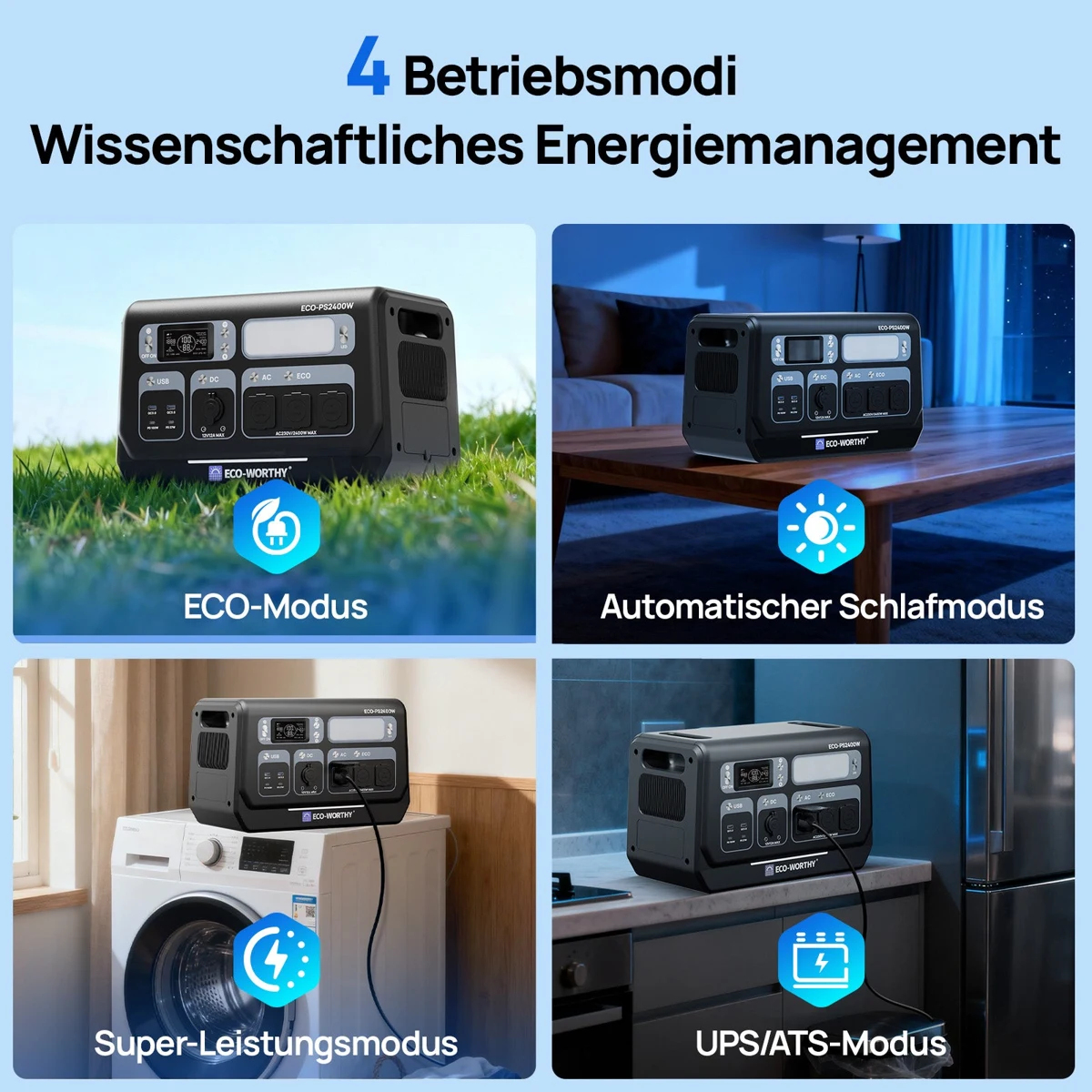
Operating modes: ECO, auto-sleep, Super Power, UPS and ATS
ECO mode works when the AC output is on. It switches the AC output off automatically after 4 hours at a load of 50W or less, or with no load, to save energy; turn ECO off for small continuous AC loads such as a router. With ECO off, auto-sleep still guards against a forgotten output draining the battery: when the station is not charging and the AC, DC and USB outputs draw 2W or less, it switches itself off after 1 hour.
Super Power Mode is off by default and is enabled in the LANDBOOK app. It lets the station run purely resistive appliances, such as kettles or heaters, of up to 3,600W, while the rated output remains 2,400W. It is not available while the station is charging from mains or a generator, because the AC source then supplies the outlets directly.
In UPS bypass mode, with mains connected and the AC output on, mains power supplies the AC outlets directly and recharges the battery; the inverter is not used, and the bypass limit is 1,800W. With ATS switched on in the app, or by holding the AC button for 3 seconds, the UPS function re-engages automatically after each power cut without pressing the AC button.
Side-panel connections, display and controls
| Battery expansion port | For one expansion battery; up to 4096 Wh in total |
|---|---|
| CT/485 port | Service and future functions; not a power output |
| Grounding terminal | For appliances that require earthing |
| AC circuit breaker | 250 V AC / 15 A; trips above 15 A or 2500 W |
| Display | LCD: power in and out, battery %, remaining time, modes and warnings |
| Buttons | Power, USB, DC, AC, ECO, LED, Wi-Fi and AC charging mode |
| LED light | 3 W, three levels (L/M/H) and SOS |
| Cooling | Temperature-controlled fans |
The manual states that one expansion battery doubles capacity to 4,096Wh; the compatible battery is not named in the supplied documents and is not included or sold here. The CT/485 port is reserved for after-sales service and future functions. If the AC output exceeds 15A or 2,500W, the circuit breaker trips; press it to reset once the cause has been removed. The LCD shows input and output power, battery percentage, remaining time, active outputs, charging mode, ECO and UPS status, Wi-Fi and solar input, plus overload, short-circuit and temperature warnings.
In the box
ECO-PS2400W power station, AC charging cable, vehicle charging cable (XT60 to car plug), solar charging cable (XT60 to MC4) and user manual. Solar panels and an expansion battery are not included.
Monitoring, portability and operating limits
Wi-Fi and Bluetooth connect the station to the LANDBOOK app for real-time status, settings and the operating modes above. The manufacturer states 3,500 cycles with state of health at least 70%; this does not establish a guaranteed calendar service life. The 23.5kg unit measures 465 x 260 x 295mm and has carrying handles on both sides. Use it within 0 to 40°C for charging and -10 to 40°C for discharge, with appropriate ventilation and a dry, suitable location; it is not waterproof. For storage, keep it dry at -20 to 60°C and recharge it at least every three months. The battery is not user-replaceable, and the station cannot jump-start a vehicle. Read the EU manual for handling and supplied lead details before use.
Frequently asked questions
Can I charge a laptop over USB-C?
USB-C output 1 supports USB Power Delivery up to 100W (20V / 5A), which covers many laptops that charge over USB-C PD; use a cable rated for 5A / 100W to reach the full rating. USB-C output 2 is limited to 27W and suits phones, tablets and other small devices. A laptop that needs more than 100W, or uses a barrel or proprietary charger, can run from its own adapter on an AC outlet.
Does the UPS function support the full 2400W rating?
No. The documented UPS bypass limit is 1,800W, which differs from the 2,400W continuous inverter rating, so do not plan bypass operation from the larger number. ECO-WORTHY’s EU product page states a switchover time of under 10ms; that figure is not in the manual or datasheet and has not been tested by PVShop. Check suitability for a specific computer or sensitive load before relying on it; a UPS label alone is not a zero-interruption guarantee.
Which solar panels can I connect?
Panels or arrays whose open-circuit voltage, including the cold-weather rise, stays within 16 to 100V DC, with a current of up to 25A, connected through the supplied XT60-to-MC4 cable. The solar input accepts up to 1,200W. The manufacturer quotes about 6 to 7 hours to charge from two 200W panels in full sun.
How long will a computer or appliance run?
Use the measured combined power consumption, not the appliance PSU label. The EU manual estimates runtime as 2,048Wh × 90% ÷ load in watts, for example about 1.8 hours at 1,000W. Conversion losses, inverter standby draw, temperature and reserve reduce practical runtime, and compressor appliances such as fridges vary with their duty cycle. High-startup loads must also stay within the relevant output limits. No appliance-specific runtime or recharge time has been independently measured by PVShop.
What happens when the battery runs low?
To protect the battery’s cycle life, the AC outlets switch off at 5% remaining charge and the DC and USB outputs at 3%. The manual recommends recharging when the level falls to 20%.
Delivery to the EU
Estimated total processing and delivery from European stock: 7–10 days. The supplier confirmed this estimate on 29 September 2026. Delivery is offered to EU countries; estimates are not a guarantee.