Description
A desktop PC without the inverter
In a camper, a boat or an off-grid building, a desktop computer usually converts its power twice: battery DC to mains AC through an inverter, then back to DC inside the PC’s own power supply. Every conversion turns part of your battery into heat. This board replaces the mains power supply and converts a DC source straight into the rails the motherboard, processor, graphics card and drives need.
Conventional build
Battery DC → inverter → mains PSU → PC
Direct DC-ATX build
Battery DC → DC-ATX supply → PC
It is not a mains power supply and it is not an inverter. It is an open board that expects a DC source inside its documented input range, and it needs to be planned with that source.
The output rails
These are the manufacturer’s published figures for this model. The +12V rail carries the processor and the graphics card, so its full-load rating is the number that decides whether a build fits.
| Rail | Maximum | Full load | Tolerance | Ripple |
|---|---|---|---|---|
| +12V | 55A | 45A | 1% | 10mV |
| +5V | 10A | 8A | 1% | 10mV |
| +3.3V | 10A | 8A | 1% | 10mV |
| +5VSB | 2A | 1.5A | 3% | 10mV |
The board is rated at 500W continuous with a 600W peak. The manufacturer does not publish how long the peak may last, so treat 500W as the working figure for planning. Overall DC-DC efficiency is stated as better than 94%, and the low ripple figure is the manufacturer’s reason for recommending this board for computer audio and compact gaming systems.
A 12–48V input range
The input accepts 12V to 48V DC through a screw-lock 7.4 × 5.0 mm jack with a centre pin for ground, or through the 8-pin Molex input. That range covers a 12V, 24V or 48V nominal battery system without a separate converter stage.
One honest limit: the manufacturer publishes a single 500W figure and no derating curve. Current drawn from the battery rises as system voltage falls, so we cannot state how much of that 500W is available at 12V — the documentation simply does not say. For a full-output build, plan around a 24V or 48V system, keep the DC feed short and thick, and fuse it at the battery for the current the board can draw rather than for your measured load.
The manufacturer also publishes no no-load or standby consumption figure for this model, so we do not quote one. If idle drain matters for your system, measure it before you commit.
Connections
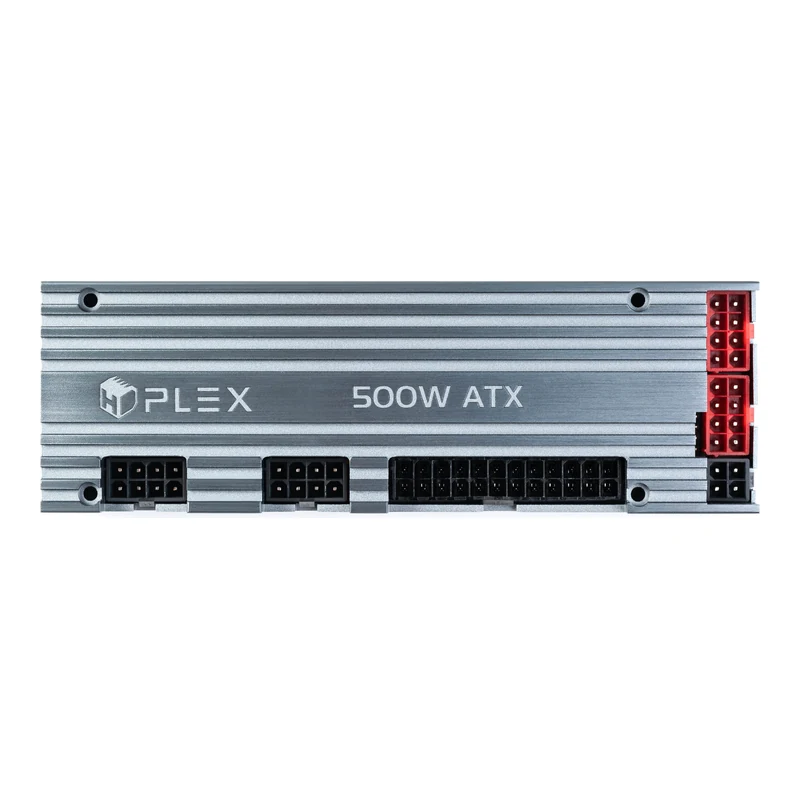
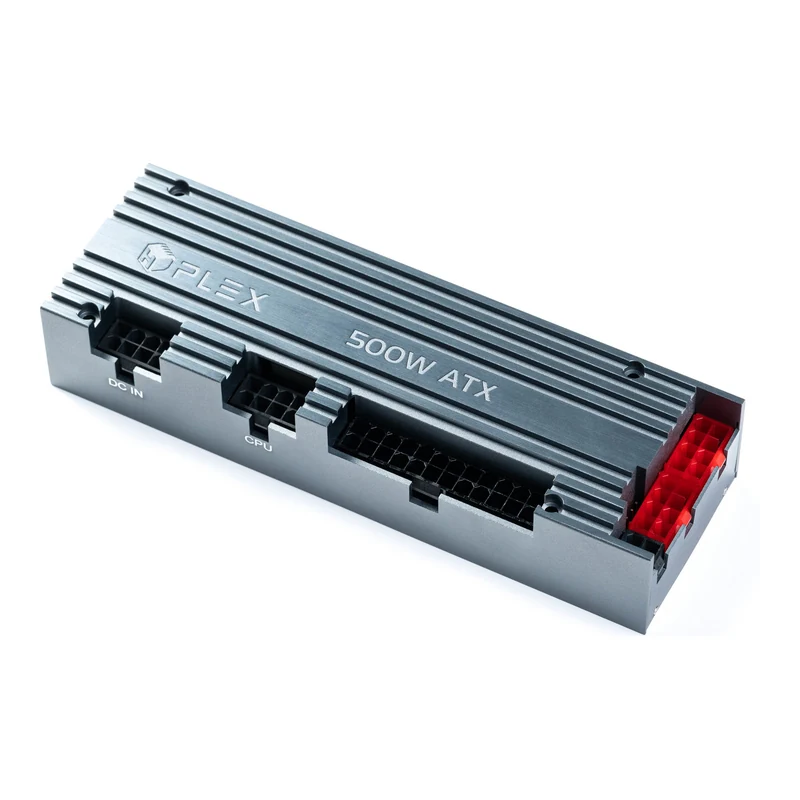
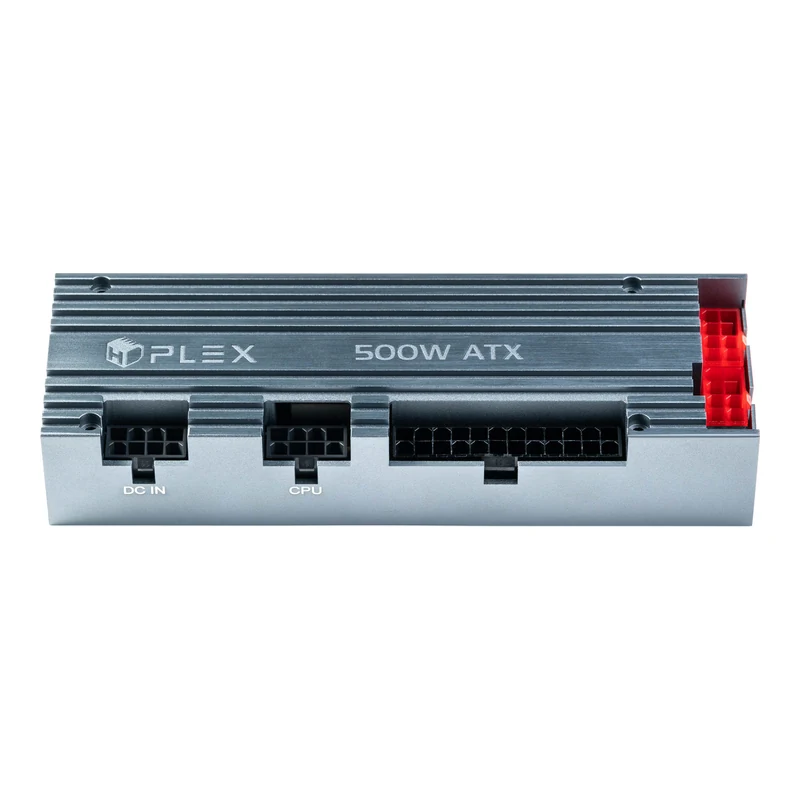
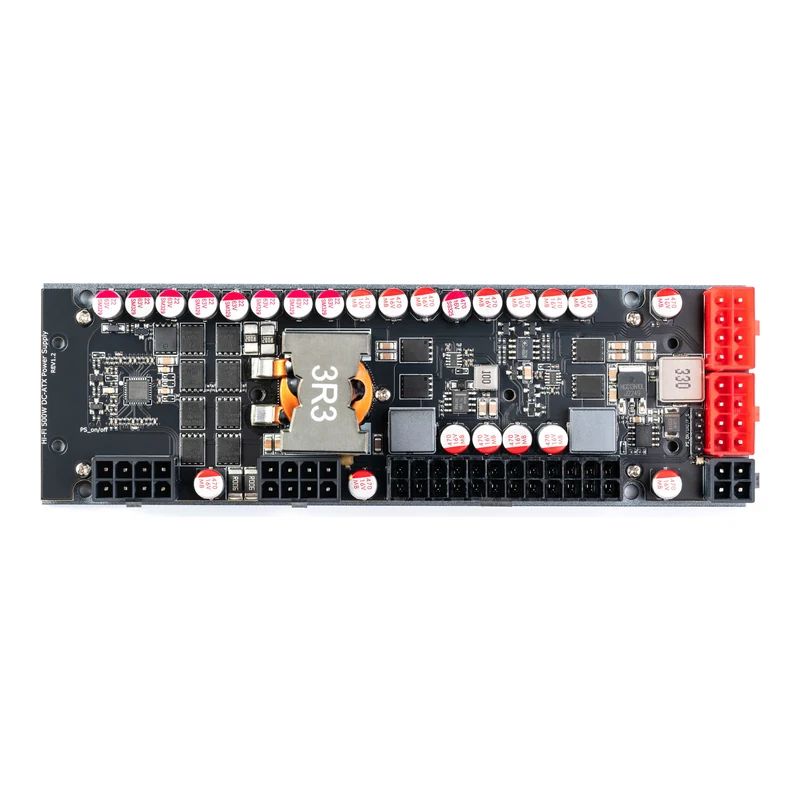
The output is modular: the board carries Mini-Fit Jr headers at 4.20 mm pitch and the cables are supplied.
- 24-pin ATX main power, standard pinout.
- 8-pin CPU EPS, supplied as a 4+4 cable.
- Two PCIe 8-pin outputs, supplied as one dual 6+2 cable.
- 4-pin SATA output, supplied as a cable with four SATA connectors.
- PS-ON header: short it to ground to switch the supply on. PWR-OK header: outputs a +5V signal once the supply is running.
The manufacturer states that the modular output is compatible with third-party cable sets made for the Silverstone ST series, which matters if you already own a set or want custom lengths.
In the box
- 1 × 500W DC-ATX power supply (12–48V input)
- 1 × 24-pin to 20+4-pin ATX cable, 40 cm
- 1 × 8-pin to 4+4-pin CPU EPS cable, 45 cm
- 1 × 8-pin to dual 6+2-pin PCIe cable, 45 cm
- 1 × 4-pin to four SATA power cable, 45 cm
- 1 × 7.4 × 5.0 mm self-lock DC input to 8-pin Molex cable, 45 cm, with M12 mounting ring (adapter plate not included)
Cooling, mounting and protection
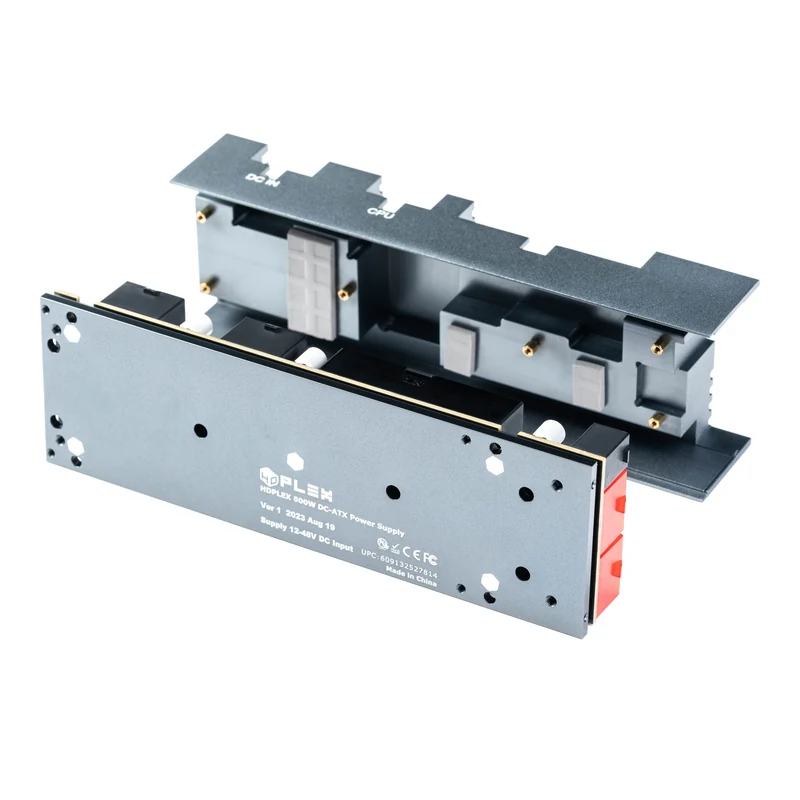
There is no fan. Two heatsinks — one on the switching devices, one on the board — carry the heat away, so the installation does the cooling: mount it where air can move and never bury it in a sealed, insulated space.
The board measures 160 × 52 × 31 mm without cables. Mounting holes are spaced 122.3 × 43.3 mm and take M3 screws through a 3.2 mm hole. The documented operating range is −10 °C to 70 °C.
Protection covers over-voltage, overload, over-current, short circuit and under-voltage. The board carries CE, FCC and RoHS certification and is built with Würth Elektronik inductors, WIMA and solid-state capacitors, Infineon MOSFETs and a Texas Instruments LM2642 control chip on an 8-layer, 2 oz copper board — the manufacturer’s own description of the build.
What to check before you buy
- The +12V budget. Add the documented figures for your processor and graphics card and keep them inside 45A continuous. Check the PCIe connector count too: this board provides two.
- Your system voltage and the missing derating data. 12V is inside the documented input range, but the available power at 12V is not published. If you need the full 500W, plan on 24V or 48V.
- Airflow. Fanless means the enclosure has to remove the heat. Give it free air and a metal mounting surface if you can.
- Cabling and fusing. Fuse at the battery, size the fuse for the cable and the board’s input current, and keep the run short.
- What is not claimed. There is no ATX 3.x or 12VHPWR support stated, no peak duration, and no no-load consumption figure. Modern high-power graphics cards that need a 12VHPWR connector are outside what this board documents.
- Mains operation. If you intend to run it from a mains adapter instead of a battery, the manufacturer recommends a 330W Dell LA330PM160 adapter for a full-output build. That adapter is not included.
Download the PVShop technical datasheet (PDF)
Questions about this DC-ATX supply
Will it run from a 12V battery?
12V is inside the documented input range, so yes in principle. What the manufacturer does not publish is how much of the 500W is available at 12V, because no derating curve is given. At 12V the board also draws roughly four times the current it would need at 48V, so the feed, the connectors and the fusing all have to suit that.
Can it power a gaming PC?
Within its rail limits and connector count. The processor and graphics card both load +12V, which is rated 45A at full load, and the board provides two PCIe 8-pin outputs. Check your card’s documented power and its connector requirement against that.
Do I still need an inverter?
Not for the PC tower, provided the DC source suits the board. Monitors and other mains-only equipment may still need one.
Is 600W peak the same as 600W continuous?
No, and the manufacturer publishes no duration for the peak, so plan on 500W continuous.
Is the ripple low enough for audio equipment?
The manufacturer states 10mV maximum ripple and noise on every rail and recommends the board for computer audio systems. That is their published figure; PVShop has not measured it independently.
Every electrical figure on this page is the manufacturer’s published specification for this exact model. Nothing here has been independently tested by PVShop, and no value has been calculated, converted or estimated. Installing a DC power supply is a wiring task: observe polarity, fuse the feed, and follow the model’s documentation.