For a small, simple system such as a camper van, a small boat or a little cabin with a few lights, a fridge and a laptop, choose 12 V. With a larger inverter (roughly 1,500–3,000 W), long cable runs or more power, 24 V is usually the better fit. For whole-home or fully off-grid cabin storage and inverters above about 3 kW, 48 V is the normal choice. These are common installer rules of thumb, not hard limits.
The reason is arithmetic. A lithium iron phosphate (LiFePO4) battery delivers power as voltage times current, so at the same power a higher-voltage bank carries less current, and current is what heats cables and drops voltage along the wire. The trade-off is that every DC-side part must be chosen for the voltage you pick.
Why voltage matters: power, current and cable losses
Power is voltage times current: P = V × I, so I = P ÷ V. Doubling the voltage halves the current for the same load. The table gives the DC current for three loads.
| Load | 12 V | 24 V | 48 V |
|---|---|---|---|
| 1,000 W | 83 A | 42 A | 21 A |
| 2,000 W | 167 A | 83 A | 42 A |
| 3,000 W | 250 A | 125 A | 63 A |
These are minimum figures: inverters and converters are not 100% efficient, so the real battery current is higher. Assuming, for illustration, 90% efficiency (use your inverter’s documented figure), a 2,000 W AC load needs about 2,222 W from the battery, which is roughly 185 A at 12 V, 93 A at 24 V and 46 A at 48 V.
Cable heating equals I² × R, so halving the current cuts the loss to a quarter. Doubling the system voltage therefore cuts cable loss, and the voltage drop as a share of the supply, to a quarter.
Worked example
Take 1,000 W through cables with an assumed round-trip resistance of 5 mΩ. At 12 V the current is about 83 A, the cables lose about 35 W and the voltage drops about 0.42 V (3.5%). At 24 V it is about 42 A, 8.7 W and 0.21 V (0.9%). At 48 V it is about 21 A, 2.2 W and 0.10 V (0.2%). The 5 mΩ is an illustration, not a recommendation: size real cable for the current, the run length and the voltage drop you allow.
LiFePO4 pack voltages: 12.8 V, 25.6 V and 51.2 V
A LiFePO4 cell has a nominal voltage of 3.2 V and is typically charged to about 3.45–3.65 V. Cells in series add their voltages, so a nominal 12 V LiFePO4 battery is really 12.8 V. The full-charge column uses 3.65 V per cell.
| System | Cells in series | Nominal voltage | Full-charge voltage |
|---|---|---|---|
| 12 V | 4S | 12.8 V | 14.6 V |
| 24 V | 8S | 25.6 V | 29.2 V |
| 36 V | 12S | 38.4 V | 43.8 V |
| 48 V | 16S | 51.2 V | 58.4 V |
36 V (12S) is a niche voltage. Many manufacturers specify a lower charge voltage than 3.65 V per cell, so follow your battery’s datasheet.
Voltage does not change the energy stored: energy is voltage times capacity, so a 12.8 V 200 Ah battery and a 25.6 V 100 Ah battery both hold 2,560 Wh. Size the bank in watt-hours first, as in the guide to sizing a LiFePO4 battery bank, then choose the voltage.
Which voltage suits which inverter size
The inverter is usually the largest load, so it usually decides the voltage. Common installer rules of thumb:
- 12 V: inverters up to about 1,000–1,500 W, such as a camper van with a few small appliances.
- 24 V: about 1,500–3,000 W, such as a boat galley or a larger motorhome, with half the current of 12 V.
- 48 V: above about 3 kW, and whole-home or off-grid cabin systems.
These are conventions, not limits: higher-rated 12 V inverters and small 48 V ones both exist. What counts is the battery current at full load, including efficiency loss, and the start-up surge of motors such as compressors, set against the battery’s documented maximum discharge current. To size the inverter itself, see the guide to sizing a pure sine wave inverter.
What you already own: alternators, loads and converters
Vehicle and boat starting systems are 12 V (cars, vans, most small boats) or 24 V (many trucks, buses and larger boats). A lithium bank is best charged from an alternator through a DC-DC charger, at any voltage. If the voltages differ, the charger must also step up or down, so check its documented input and output voltages. A step-up charger draws more on its input: 30 A into a 24 V bank is about 720 W, or about 60 A from 12 V before losses.
Your loads are the other half. Most camper and boat accessories, such as lights, pumps, fans, fridges and routers, are made for 12 V, though many accept 12 V and 24 V. On a 24 V or 48 V bank, 12 V equipment needs a DC-DC converter to step the voltage down; the guide to DC-DC converters explains how. Converters have their own losses, so the more 12 V equipment you own, the stronger the case for staying at 12 V.
Safety at 12 V, 24 V and 48 V
Low voltage is not low energy
A 48 V nominal LiFePO4 bank charges to 58.4 V, below the 60 V DC level that many standards treat as the upper limit of extra-low voltage (the exact definition depends on the standard and country). That lowers the shock risk, but it does not make the battery harmless: at 12 V, 24 V or 48 V a lithium battery can deliver a very high current into a short circuit, enough to melt tools and start a fire.
Fuse at the battery, never bypass the BMS and size cable for the current and the voltage drop you allow. Fuses, breakers and switches need a DC rating at or above the bank’s full-charge voltage; a device rated only for 12 V or AC is not suitable at 48 V. The inverter’s AC output is mains voltage whatever the battery voltage, so use a qualified installer for fixed installations and mains wiring.
Growing the system: series, parallel and changing voltage later
Two identical 12.8 V batteries in series make a 25.6 V (24 V nominal) bank with the same amp-hour capacity; four make 51.2 V (48 V nominal). In parallel the voltage stays the same and the capacities add. Do this only if the manufacturer states that series or parallel connection is permitted, and use identical batteries at the same state of charge. The guide to series and parallel wiring shows the patterns.
Changing voltage later means more than rewiring: a new inverter, and checked or replaced chargers, solar controller, DC-DC converters and fuses. If you expect to need a large inverter eventually, choose the voltage for that inverter now.
Decision checklist and batteries to compare
- List your loads in watts and find the largest, usually the inverter, including its start-up surge.
- Estimate daily energy in watt-hours and size the bank by energy first.
- Work out the battery current at full load, including inverter losses; if it is well above about 100–150 A, consider the next voltage up.
- Note your vehicle’s alternator voltage and how many 12 V devices you own, to see where a DC-DC charger and converters are needed.
- Measure the cable runs between battery, fuse and inverter; long runs favour a higher voltage.
- Confirm every DC component and fuse is documented for the chosen voltage, including its full-charge voltage.
LiFePO4 batteries at 12 V, 24 V and 48 V


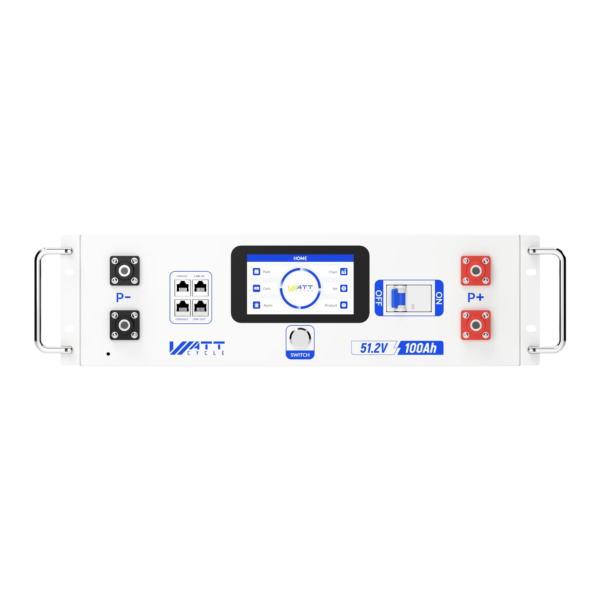
100 Ah · LiFePO4
WattCycle 48V 100Ah 3U Server Rack LiFePO4 Battery with Bluetooth
Once you have chosen a voltage, open the product page of a card at that voltage and compare its documented nominal voltage, capacity, maximum continuous discharge and charge current, BMS details and whether series or parallel connection is permitted.
Frequently asked questions
Can I run 12 V and 24 V loads on the same system?+
Yes, but not by tapping one battery of a series string. Run the bank at one voltage and step it down with a DC-DC converter for the 12 V loads. Tapping just one battery drains it faster than its partner and unbalances the pair.
Is 24 V more efficient than 12 V?+
For the same power, 24 V carries half the current, so cable and connector losses fall to a quarter. Whether an inverter or converter itself is more efficient at 24 V depends on its design, so read the documented efficiency of the exact model.
Can I change my system from 12 V to 24 V later?+
Yes. Batteries rated for series connection can be rewired to 24 V, but the inverter, chargers, solar controller, DC-DC converters and fuses must all match the new voltage. A 12 V inverter must not be connected to a 24 V bank.
Do I need a special inverter for 48 V?+
Yes. An inverter’s DC input is designed for one battery voltage (a few accept a documented range), so a 48 V system needs a 48 V inverter. Check that its documented input range covers the full-charge voltage of 58.4 V and that its low-voltage cut-off suits the battery.
Why do campers use 12 V?+
Because the vehicle is built around it: the alternator, starter battery and most accessories are 12 V. Loads in a van are small and cable runs short, so current stays modest, and no step-down converters are needed. A higher voltage pays off once a large inverter is added.
Currents, losses and energy figures are arithmetic examples using nominal voltages, an assumed 90% inverter efficiency and an assumed 5 mΩ cable resistance. Ratings on product pages are supplier-stated and not independently tested by PVShop. Follow the battery, inverter and converter manufacturers’ specifications; use a qualified installer for fixed installations and mains wiring.