Description
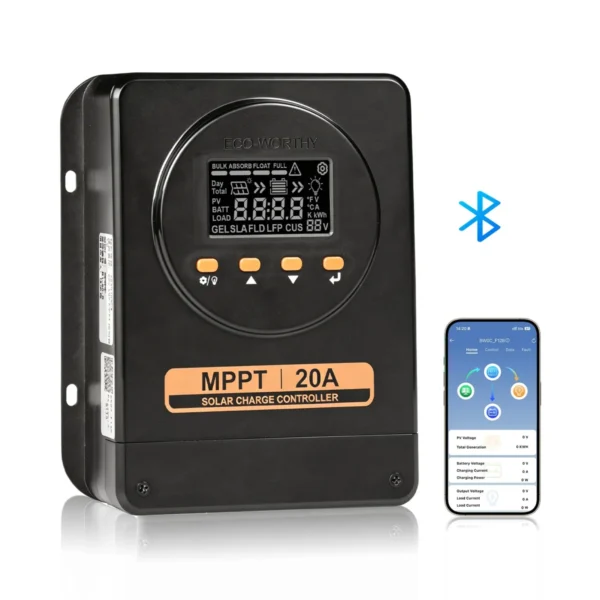
The ECO-WORTHY 40A 12V/24V MPPT solar charge controller regulates charging from a solar array into a 12V or 24V battery bank. It tracks the array’s maximum power point, offers charging profiles for LiFePO4, flooded, gel and sealed lead-acid batteries, and reports through an LCD and a built-in Bluetooth app connection. Choose it for an array of up to 600W at 12V or 1200W at 24V.
This page records the manufacturer reference for this model. The EU model listing, supplier price and availability have not yet been confirmed, so the product is out of stock and cannot be purchased, and it is not included in any PC pack.
What this model offers
The manufacturer manual states MPPT tracking efficiency of at least 99% and peak conversion efficiency of at least 98%; neither figure has been independently tested by PVShop. Lead-acid profiles add float and, depending on the chemistry, absorption and equalisation stages, while lithium batteries use the main-charge stage only. The controller also has a 20A load output with manual, light-control and timed modes, a 46 × 27mm LCD, and an input for the 1.5m battery-temperature sensor described in the manual.
Documented specifications
| Battery system voltage | 12 V / 24 V, automatic detection |
|---|---|
| Rated battery charge current | 40 A |
| Rated load current | 20 A |
| Maximum battery voltage | 32 V |
| Maximum PV input voltage (open circuit) | 100 V |
| Maximum PV input power | 600 W (12 V) / 1200 W (24 V) |
| Self-consumption | ≤ 2.3 W |
| Communication | Bluetooth |
| Battery profiles | LiFePO4, flooded lead-acid, gel, sealed lead-acid, custom (app) |
| Display | LCD 46 × 27 mm |
| Operating temperature | −10 … +60 °C |
| Dimensions (L x W x H) | 9.21 × 7.64 × 3.06 in (about 234 × 194 × 78 mm) |
| Weight | 2.13 kg |
Choosing the solar array
The manufacturer manual (model L03DZMPPT40A-1) gives a maximum PV input voltage of 100V and a maximum array power of 600W at 12V or 1200W at 24V. The controller stops charging when the PV voltage exceeds 100V and resumes below 95V. Calculate the open-circuit voltage of the series string at the coldest expected temperature, not the voltage printed on the panel label, and keep it below 100V. Do not exceed the array power limit for your system voltage; the manufacturer does not document behaviour above it.
Charging profiles and protection
LiFePO4 is the default battery profile. For a 12V system the manual lists a 14.5V main-charge voltage, an 11.2V low-voltage disconnect and a 13.0V reconnect point, and it states that every voltage parameter doubles on a 24V system. Flooded, gel, sealed and custom profiles are available, with custom values set in the app. Check the profile against your battery’s documented charge limit before first use: the PVS-LFP-12100-BT battery documents 14.5V and the PVS-LFP-24100-LED battery 29.2V, against the controller’s 14.5V (12V) and 29.0V (24V) main-charge voltages.
Documented protections include PV over-voltage, battery over-voltage, charge over-current at 40A, battery low-voltage and load over-discharge, short circuit at the battery or load terminals, reverse connection of the battery and of the PV input, internal over-temperature and an over-temperature fault from the battery-temperature sensor. The manual does not document a low-temperature charge cut-off, so rely on the battery’s own cold-charge protection and temperature limits. The controller does not replace the battery’s management system, a correctly rated fuse or breaker in each cable, or correct polarity.
Installation and wiring
Mount the controller on a vertical surface with space above and below for the cables. Connect the battery first and then the solar array; when disconnecting, remove the solar input before the battery. Size cables and fuses for 40A at the system voltage, and do not install the controller in a closed space with flooded batteries, because gas can accumulate and the heat sink can become very hot. Automatic 12V/24V detection is the default for gel, sealed and flooded profiles. For LiFePO4 the manual lists 12V as the initial system-voltage setting, so set 24V on the display or in the app before charging a 24V lithium battery.
The 20A load terminals are for small DC loads only; the manual forbids connecting inverters or battery chargers to them. They are not a power supply for a desktop PC: a 500W load at 12V would draw more than 40A. Connect larger loads, such as a DC-ATX supply, directly to the battery through their own fuse and disconnect.
Monitoring and communication
The ECO-WORTHY app (iOS and Android) connects to the controller’s built-in Bluetooth module for monitoring and parameter setting. The controller has an RJ45 interface, and the manual refers to an optional Bluetooth and WiFi module 2.0 that is not included. No Bluetooth protocol documentation is published for this model.
Manufacturer documents and included equipment
The manufacturer manual lists a 1.5m temperature sensor, five M4 × 30mm screws and five M6 × 30mm expansion tubes in the box. The datasheet and the original manufacturer manual (model L03DZMPPT40A-1, English and German) are available for download on this page; the datasheet retains the ECO-WORTHY model identity and notes where PVShop converted units.
Frequently asked questions
Can this controller charge a 24V LiFePO4 battery?
Yes, within the documented limits, but set the 24V system voltage and the LiFePO4 profile yourself on the display or in the app, and keep the array below 1200W and 100V open-circuit. The manual’s LiFePO4 main-charge voltage at 24V is 29.0V; compare it with your battery’s documented limit.
How many solar panels can I connect?
That depends on panel voltage and power, not on a panel count. Keep the combined array power at or below 600W for 12V (1200W for 24V) and the cold open-circuit voltage of each series string below 100V. Series and parallel wiring, fusing and any combiner components are the installer’s responsibility.
Can I order it or add it to a PC pack now?
No. This reference remains unpriced, out of stock and excluded from every pack until the EU offer and identity are confirmed. No dispatch or delivery date is promised. The 20A model, which is available, is the controller used in the desktop PC solar battery packs.
How does it differ from the 20A model?
The 40A model charges at up to 40A against 20A and accepts up to 100V and 600W (12V) or 1200W (24V) of array against 60V and 325W (12V) or 650W (24V). It weighs 2.13kg against 0.74kg. Both have a 20A load output and built-in Bluetooth. Choose from the array and battery limits, not from the amp rating alone.
Available now: the 20A model
ECO-WORTHY 20A 12V/24V MPPT solar charge controller (available now)
Read the desktop PC battery power guide
Delivery to the EU
No EU delivery estimate is available until the EU offer is confirmed.